Military Discount
-

-

-
0

Written by Mitchell Moss | Tile Pro Depot | Last reviewed October 8, 2026
Quick Answer: Sweep or vacuum first, wipe spills quickly, wash with a pH-neutral cleaner that suits both your tile and your grout, rinse, and let the surface dry. Save alkaline or acidic products for specific problems, test them somewhere hidden, and never combine cleaners. If grout keeps darkening, crumbling or staying damp, the cause is usually moisture or installation, and more scrubbing will not fix it.
Grout lines sit slightly below the tile surface, so they catch whatever the tile sheds: grit from shoes, kitchen grease, soap film and water. Cement-based grout is also textured and porous, which gives that material a place to settle. The routine below is built around what the manufacturers publish and what we hear most often from installers and homeowners, and it stops at the point where a cleaner is no longer the right tool.
A glazed porcelain or ceramic face is dense and smooth, so a damp cloth usually clears it. Cement grout is different. LATICRETE is direct about this in its care guidance: no cement-based grout is self-cleaning or absolutely stain-resistant. The pores take in cooking oil, coffee and wine, and in showers they hold the soap scum and moisture that mildew feeds on. Hard water adds mineral film on top of that, and an over-strong or poorly rinsed cleaner leaves its own residue, which then collects more soil.
Epoxy and other high-performance grouts absorb far less, but they are not maintenance-free. Their surface still picks up film and grime, so they need the same gentle routine. The difference is that you have more margin for error, and in most cases the manufacturer does not ask you to seal them. Check the data sheet for the specific product rather than assuming.
Before you clean anything, work out what you are cleaning. Identify the tile (glazed porcelain, unglazed ceramic, natural stone) and the grout (cement, epoxy or urethane). The right product for one can ruin the other.
Wet cleaning turns loose grit into slurry that packs into joints, so remove it dry. Sweep or vacuum with a soft brush head rather than a bare metal edge, which can scratch tile. In entries and kitchens, a doormat at each outside door does more for grout color over a year than any cleaner. Lift the mat edges and vacuum under them as well, since that is where sand collects.
Blot spills rather than wiping them across neighboring joints, then wash the spot with a compatible cleaner and rinse. Oil and dark liquids are far easier to remove in the first hour than after they have dried into unsealed cement grout.
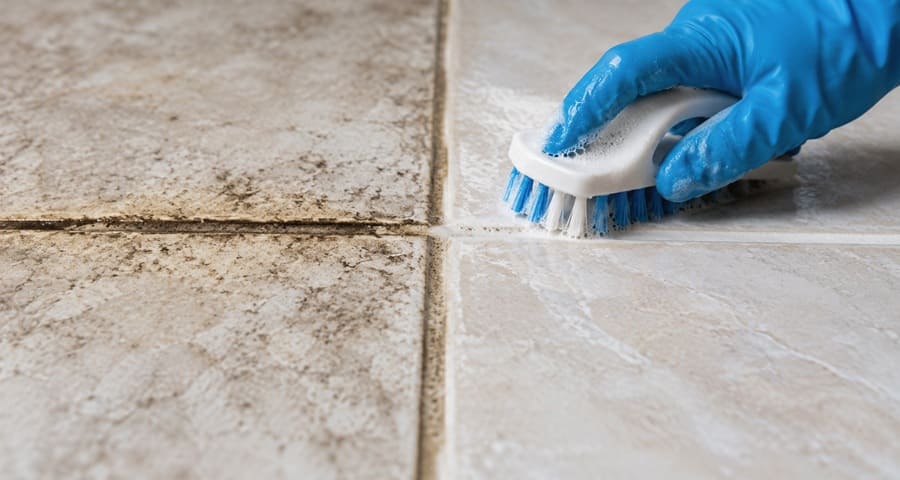
For regular washing, LATICRETE recommends a clear, pH-neutral cleaner for everyday maintenance of cement grout. Follow the label on dilution and dwell time, and work the joints lightly with a soft nylon brush. Skip wire brushes, and skip powdered scouring cleansers: LATICRETE advises against them on unsealed or unglazed tile and on many stones because the abrasive roughens the surface.
Rinsing matters more than most people expect. Damp mopping with dirty water just pushes soil into the joints, and the same goes for a mop bucket that has been through two rooms. Change the water often, and finish with clean water. Contractors cleaning large floors often use a foot-operated wringing station such as the RTC Pedal Roller Grout Cleaning Bucket, which keeps the sponge rinsed and wrung without hand wringing, so dirty water is not left in the joints. For textured floors, some pros pick up the final rinse water with a wet vacuum so it cannot settle back into the grout as it dries.
Our own guide to the best grout cleaners for tile floors compares alkaline, oxygen-bleach and chlorine-based options in more detail if you need to move beyond neutral washing.
Grease is the main enemy. A neutral cleaner handles daily film, but an alkaline degreaser is the better tool when grease has built up; LATICRETE names an alkaline cleaner for that job. Check that the product is rated for your tile and grout, apply it, let it work for the time on the label (LATICRETE’s own example calls for three to four minutes), scrub gently with a white nylon pad, and rinse well.
Here the problem is as much about moisture as dirt. The EPA’s guidance on mold is blunt: moisture control is the key to mold control, and wet materials should be dried within 24 to 48 hours. In practice that means running the exhaust fan during and after the shower, squeegeeing walls and glass, and leaving the door open so the room dries. For mildew or soap scum that has already formed, EPA recommends scrubbing hard surfaces with detergent and water and drying them completely. It describes bleach as not recommended as a routine practice in mold cleanup.
Grit and tracked-in soil darken joints close to doors first. Mats, frequent vacuuming and fresh mop water handle most of it. If joints in a high-traffic floor stay dark even after a thorough wash, that is often the point to consider a different grout when you next re-grout, such as an epoxy, rather than adding more cleaning.
Use this as a starting point, not a substitute for the product label. Always test in a hidden spot, let it dry, and judge the result dry.
| Problem | Usual starting point | Do not use on | Notes |
| Everyday film and light soil | pH-neutral tile and grout cleaner | Nothing common; still test | Rinse thoroughly; avoid excess concentration |
| Kitchen grease | Compatible alkaline degreaser | Unsealed or sensitive stone unless label allows | Short dwell, then rinse |
| Hard-water and mineral film | Product labeled for mineral deposits | Marble, travertine, limestone, other calcium-based stone | Acidic products can etch; LATICRETE cautions against acid on polished marble |
| Mildew or soap scum | Detergent and water; a product made for mildew | Do not mix with other cleaners | Fix the moisture source or it returns |
When routine washing no longer lifts the discoloration, slow down rather than escalating. Confirm the grout is sound, because loose or crumbling joints need repair, not cleaning. Protect nearby fixtures, work in small sections so the solution does not dry on the surface, give it the dwell time on the label, agitate lightly and then remove the dirty solution and rinse. Let the area dry completely before you judge it. For cement grout on porcelain or glazed ceramic, an acid-free and hypochlorite-free spray such as Fila FUGANET Grout Cleaner is one option; the manufacturer lists it for cement-based joints and says it is not suitable for polished marble, limestone or waxed porous surfaces, so match it to your tile first. Cement grout looks darker while wet, and a joint that seems stained on Tuesday may be fine by Thursday.
LATICRETE’s published approach for stubborn staining on cement grout is a good model of restraint: dampen the joint, apply the alkaline cleaner, wait a few minutes, scrub with a white nylon pad for about a minute, and repeat only if needed. If a stain survives two careful rounds, stop and call the grout manufacturer’s technical support. LATICRETE lists a technical line in its care guidance for exactly this.
Acidic cleaners dissolve mineral deposits, which is why they are marketed for grout. They also react with calcium-based stone such as marble, travertine and limestone, leaving dull, etched patches that look like permanent stains, and they can attack cement grout if left on or used too strong. LATICRETE specifically says acid-based products are not recommended for polished marble and other types of stone.
Chlorine bleach is not a universal grout cleaner either. It can lighten colored grout unevenly, and the fumes are a real hazard in a small bathroom. The most important rule is the simplest: never mix bleach with ammonia or with any other cleaner. The CDC states plainly to never mix bleach with ammonia or any other cleaner and to ventilate when using products indoors, and EPA gives the same warning about ammonia-containing products. People get hurt when they follow one cleaner with another in a closed shower without rinsing in between. If you switch products, rinse the surface thoroughly, open a window and wait.
Steam cleaners deserve a similar caution on newer grouts. LATICRETE lists steam cleaning among the aggressive regimens for which its SPECTRALOCK PRO Premium epoxy grout is not intended, so read the data sheet before using one on any epoxy joint.
A penetrating sealer on cured cement grout reduces absorption and gives you more time to clean up a spill. It does not make grout stain-proof. The joints must be clean and dry first, excess sealer should be wiped from the tile face before it cures, and the sealer will need renewing on busy floors and in showers that are washed often. A simple test: if a few drops of water darken the grout and soak in, it is time to reseal.
Some products do not need the treatment. LATICRETE states that PERMACOLOR Select does not require sealing, and epoxy grouts are generally treated the same way; follow the data sheet rather than applying sealer by habit. If you are weighing it up, our article on whether you can seal tile and grout at the same time explains when sealing both makes sense.
Some grout problems are not dirt. Missing or crumbling joints, hairline cracks that run across several tiles, and grout that is repeatedly damp point to movement, a failing bond or moisture getting where it should not. Scrubbing those joints only makes the damage worse, and they are better fixed by raking out and re-grouting, or by correcting the cause.
Natural stone adds another category. A dull patch on marble, travertine or limestone is often etching, a chemical change to the surface, not residue, and no cleaner will wash it off. When a stone floor or shower shows that kind of damage, or when you are unsure what an earlier cleaner did to it, an evaluation by professional stone restoration specialists is worth getting before anyone tries a stronger chemical or a mechanical method that could make the surface worse. The same applies to large areas of recurring mold. EPA suggests getting professional help when the affected area is bigger than roughly 10 square feet.
Most of the work is habit rather than product. Dry-clean often, blot spills, wash with a neutral cleaner, rinse, and dry wet areas. Test everything stronger before you use it, and treat persistent damp, cracking or etching as a diagnosis problem. Done consistently, that keeps cement grout presentable for years and keeps epoxy looking close to how it did the day it was installed.
Sweep or vacuum floors as often as you normally would, and do a neutral wash weekly or every other week in kitchens and bathrooms, or sooner if you see film. Showers benefit from a quick squeegee after each use. Deep cleaning is occasional, not a schedule; do it when routine washing stops working.
Not on every installation. Vinegar is acidic, so it can etch marble, travertine and limestone, and it is not a good choice on cement grout when used repeatedly or left to sit. Poison Control warns that vinegar mixed with chlorine bleach creates highly irritating chlorine gas. If you want to try it on porcelain or ceramic, dilute it, test a hidden spot and rinse well, and never mix it with bleach.
It is sometimes used, but it is not the first choice. It can lighten colored grout unevenly, and EPA does not recommend bleach as a routine step in mold cleanup. If you do use it, use it alone, ventilate the room and rinse thoroughly. Never mix it with ammonia or any other cleaner.
Usually one of three things: leftover cleaner or dirty rinse water drying into the pores, grout that is still wet and therefore looks darker, or a moisture problem in the room. Rinse with clean water, let the grout dry fully, and check ventilation before repeating the cleaning.
Yes, though less often. Epoxy absorbs very little, so soil sits on the surface, but film and residue still build up. Use neutral cleaners and soft tools, avoid aggressive regimens such as steam unless the data sheet allows them, and follow the manufacturer’s guidance for the specific product.
When joints are cracked, powdery, missing or repeatedly damp, or when staining has gone through the full thickness of the joint and survives gentle cleaning. Re-grouting gives a fresh start; deep stain removal rarely does. For anything involving movement or leaks, find the cause first.
This article is general educational information for homeowners and tile professionals and is not a substitute for the instructions of the tile, grout or cleaner manufacturer, local building codes or the advice of a qualified professional. Products, labels and data sheets change, so always read the current label and technical data sheet and test cleaning methods on a small, inconspicuous area before applying them. Tile Pro Depot is not responsible for damage or injury resulting from the use or misuse of cleaning products. Never mix cleaning chemicals, and ventilate any space where you use them.

Mitchell Moss works with Tile Pro Depot and contributes practical content for professional tile installers, remodelers, and serious DIY users. His articles focus on tile installation tools, setting materials, waterproofing systems, grout, underlayments, and jobsite techniques. Through the Tile Pro Depot blog, he helps readers better understand product applications, compare installation approaches, and make informed material choices using manufacturer guidance, industry standards, and practical considerations that can affect the durability and performance of a tile installation.