Military Discount

-

-

-
0

Written by Mitchell Moss | Tile Pro Depot | Last reviewed October 24, 2026
The short version: Treat every pallet as heavier and slipperier than it looks. Under the FMCSA cargo securement rules, the combined working load limit of your tie downs must be at least half the weight of the load, and a pallet of 5 feet or less that weighs more than 1,100 pounds needs at least two. Use rated hardware, protect straps from sharp corners, and check the load within the first 50 miles.
A pallet of porcelain tile, a stack of cement board and a few bags of thinset add up to the kind of load that punishes shortcuts. The weight sits on a small footprint, shrink wrap is slick, and the first hard stop will find any slack in your straps. Most flatbeds, stake-bed trucks and utility trailers already have a place to anchor that load: the stake pockets along the deck edge. This guide explains what the hardware in those pockets can and cannot do, what the federal rules require, and how to apply both to the materials tile crews haul.
Strictly, the FMCSA rules cover cargo-carrying commercial motor vehicles, as defined in 49 CFR 390.5, that operate in interstate commerce. A contractor pulling a trailer for personal use or purely within one state may fall under state law instead. Many states adopt similar standards, and the federal rules are a widely used benchmark for safe securement, so following them is sensible either way. If you are unsure which rules govern your vehicle, ask your state’s motor carrier or highway patrol office.
Two performance numbers sit behind everything below. FMCSA says a securement system must withstand 0.8 g of forward deceleration and 0.5 g of rearward and sideways acceleration, applied separately. In plain terms, that is a hard stop, which is exactly the situation that moves a pallet of tile.
Two rules decide how much restraint you need. The first, in 49 CFR 393.106, is that the aggregate working load limit (WLL) of your tie downs must be at least half the weight of the cargo. The second, in 49 CFR 393.110, sets a minimum number of tie downs for cargo that is not blocked against forward movement:
| Item length and weight | Minimum tie downs |
| 5 feet or less, and 1,100 lb or less | 1 |
| 5 feet or less, and more than 1,100 lb | 2 |
| Longer than 5 feet, up to 10 feet (any weight) | 2 |
| Longer than 10 feet | 2, plus 1 more for every 10 feet (or fraction) beyond the first 10 feet |
If the load is blocked against a headerboard, bulkhead or other secured cargo, the minimum drops to one tie down for every 10 feet of length or fraction of it. Those are minimums, not targets, and they sit on top of the 50 percent WLL requirement.
Here is an illustrative example. Say a pallet of tile is 4 feet long and the bill of lading says it weighs 2,000 pounds. Because it is 5 feet or less and over 1,100 pounds, you need at least two tie downs. The aggregate WLL must be at least 1,000 pounds. FMCSA counts a tie down that runs over the cargo and back to the vehicle at its full WLL, while one that runs from a vehicle anchor point to the cargo counts at half. So two straps looped over the pallet, each rated at 1,500 pounds, give an aggregate of 3,000 pounds and meet both rules on paper. Most crews would still add a third or fourth strap, because the rules assume rated, undamaged hardware and a load that cannot slide inside its own shrink wrap. Use the weight on your own paperwork, not this example.
Stake pockets are the square or rectangular sockets along the edge of a truck bed or trailer deck. Hardware that drops into them gives you a low, solid anchor point for straps, chains and binders, which beats looping a strap around a rail and hoping.
The weak link rule matters here. FMCSA treats the WLL of a tie down as the lowest WLL of its components, or of the anchor point it attaches to, whichever is less. A chain rated at 6,600 pounds on a 5,000-pound binder is a 5,000-pound tie down. The same logic applies to the pocket: 49 CFR 393.104 requires vehicle structures and anchor points to be strong enough to meet the performance criteria, with no damaged or weakened components. A strong D-ring does not help if the pocket it sits in is bent, rusted through or only lightly welded.
As an example of what spec sheets look like, one manufacturer lists a stake pocket tie down set with a steel D-ring rated at a 4,000-pound working load limit and a 12,000-pound breaking limit, for pockets up to about 3-1/4 inches tall, and says it converts a stock pocket into an elevated anchor without welding. Note what that listing does and does not say. It rates the D-ring, and it does not state whether that rating covers the pin and channel assembly or your truck’s pocket. Whatever you buy, check that the WLL is stated, that it matches your straps or chain, that it fits your pocket snugly so it does not rattle, and that the welds, forging and finish are sound. Rust at the base or a bent loop is a reason to replace it.
49 CFR 393.104 also requires edge protection wherever a tie down would be subject to abrasion or cutting, and that protection must resist abrasion, cutting and crushing. Boxed tile has sharp corners and banded pallets have hard edges, so corner guards are a small cost that protects the strap and the load. The same section says damaged or weakened components must not be used, and that each tie down must be attached so it cannot become loose in transit. A frayed or cut strap goes in the bin, not back on the truck.
Blocking helps too. Pushing the pallets tight against a headerboard or bulkhead changes the minimum count, as the rule above shows, and it limits how far anything can travel if a strap does slacken.
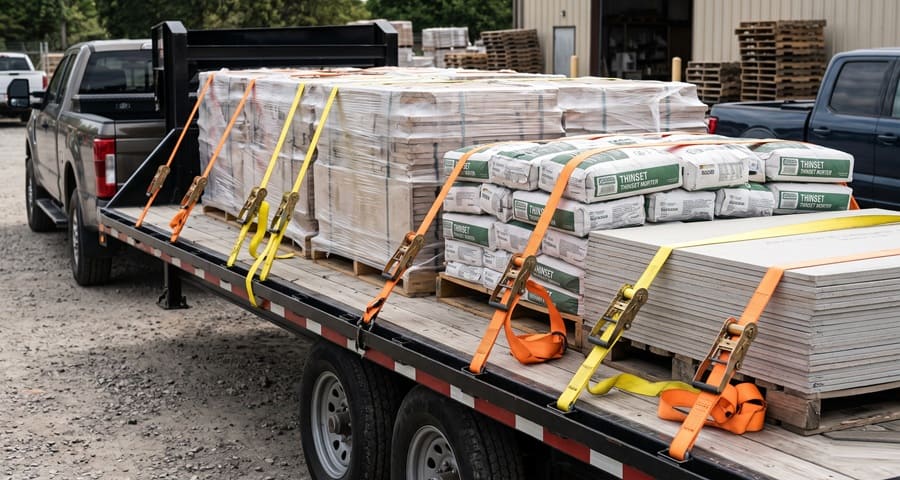
Weight is concentrated on a small footprint, and shrink wrap lets the top layers slide against each other. Strap over the top, tight to the deck, and do not rely on the wrap to hold the stack together. Stack pallets only when the lower pallet can carry the weight, and strap each pallet as its own unit.
Sheets are bulky, heavy and prone to edge damage. Our comparison of uncoupling membranes and backer board notes that cement board makes for repeated trips, and that a membrane roll covering 323 square feet weighs about 40 pounds while the same area of cement board weighs hundreds. That gap is a good reminder to weigh the load, not guess. Lay sheets flat, support them along their length, and use edge protection because the corners chip and cut straps.
Bags are less of a shifting risk than a moisture risk. Cement-based setting materials can be ruined by wet weather in an open bed, so cover them and check the manufacturer’s storage instructions on the bag. Keep bags off the deck edge, where a wet strap can soak them, and do not let a strap cut across a bag seam.
FMCSA’s inspection rule is in 49 CFR 392.9. It requires drivers of commercial motor vehicles to inspect the cargo and securement devices within the first 50 miles of a trip. After that, the load must be re-examined when the driver changes duty status and after the vehicle has been driven for 3 hours or 150 miles, whichever comes first. Any contractor can follow the same rhythm. Before pulling out, confirm each tie down is fully seated in its pocket and the straps and chains have no cuts, frays or bent links. Keep tie-down angles consistent so the load is pulled down and back, not just sideways. After a few miles, stop somewhere safe and re-tighten, because settling loads slacken straps.
The best tie-down plan is the one a crew actually repeats. Keep rated hardware on the truck, replace anything that looks tired, and treat securement like layout: measure twice before the cut, and check twice before the road.
At least one if the pallet is 5 feet or less and 1,100 pounds or less, and at least two if it is heavier, under 49 CFR 393.110. The combined working load limit must also be at least half the cargo’s weight. Most crews use more than the minimum on tile because the weight is concentrated and the shrink wrap is slippery.
They apply to commercial motor vehicles operating in interstate commerce. Personal-use and intrastate hauling is often governed by state law, which in many states is modeled on the federal rules. Using the FMCSA standard is a sensible benchmark either way.
It depends on the vehicle. The rules require anchor points to be strong enough for the load and free of damage, so check the manufacturer’s rating for your truck bed or trailer deck, and inspect pockets for rust, bends and weak welds. A D-ring’s rating does not raise the pocket’s rating.
Either can meet the rule if its working load limit and condition are right. Straps need edge protection on sharp corners, and a chain’s WLL is limited by its weakest link or binder. Whichever you choose, keep the WLL documented and retire anything damaged.
Within the first 50 miles, then after every 3 hours or 150 miles of driving, and, as good practice, whenever you stop. Commercial drivers must also re-examine the load when their duty status changes. Re-checking after the first few miles is especially useful because settling can loosen straps.
No. FMCSA’s rules say damaged or weakened components must not be used, because they reduce the working load limit of the whole securement system.
This article is general educational information and is not legal, safety or engineering advice. Cargo securement requirements depend on your vehicle, cargo, route and jurisdiction, and regulations are updated from time to time. Always check the current text of the rules that apply to you, follow the vehicle, trailer and hardware manufacturers’ load ratings, and consult your state motor carrier authority or a qualified professional if you are unsure. The worked example is illustrative; use the actual weight and dimensions of your load. Tile Pro Depot is not responsible for damage or injury resulting from the use of this information.

Mitchell Moss works with Tile Pro Depot and contributes practical content for professional tile installers, remodelers, and serious DIY users. His articles focus on tile installation tools, setting materials, waterproofing systems, grout, underlayments, and jobsite techniques. Through the Tile Pro Depot blog, he helps readers better understand product applications, compare installation approaches, and make informed material choices using manufacturer guidance, industry standards, and practical considerations that can affect the durability and performance of a tile installation.