Military Discount
-

-

-
0

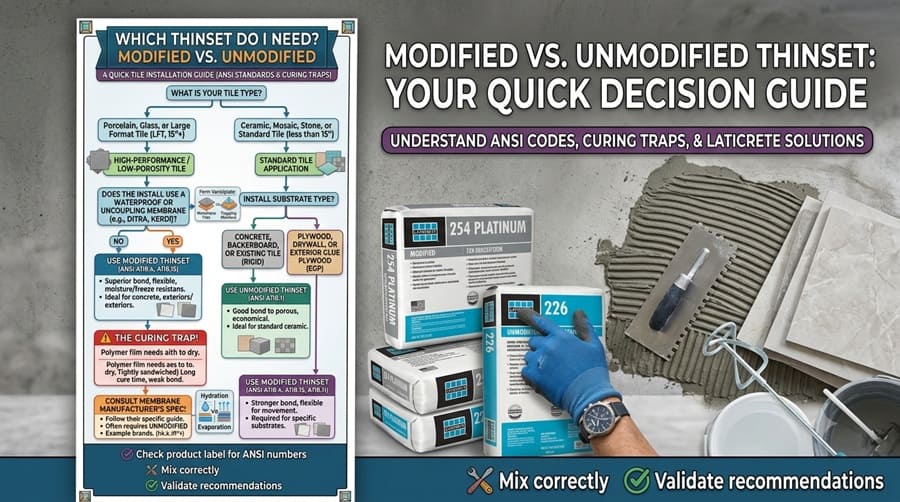
Every bag of thinset says “thinset” on the front, but the answer that actually matters is on the back label: the ANSI number. That number — not the marketing copy — tells you whether you’re holding modified or unmodified mortar, and it’s what your tile manufacturer’s spec sheet, membrane manufacturer, or inspector will reference.
Here’s how to read those codes, what’s actually different about each mortar, and where each one belongs on a real installation.
Skip the guesswork and check the label:
A bag listing only A118.1 is unmodified. A bag listing A118.1 alongside A118.4, A118.11, or A118.15 is modified — the A118.1 reference there just confirms it also clears the baseline unmodified bond requirements. Some bags add letter suffixes too: E for extended open time, T for non-sag on verticals, H for large and heavy tile, F for fast-set. Worth checking if a tile manufacturer’s spec calls for one of those.
Unmodified thinset — also called dry-set mortar — is Portland cement, fine sand, and a water-retaining agent, mixed on site with plain water. No polymers or latex resins are added at the factory.
Because it’s a simpler formula, unmodified thinset:
Modified thinset starts with the same cement-and-sand base, but the manufacturer blends in dry polymer or latex resin (some installers instead buy an unmodified powder and mix in a separate liquid latex additive on site). Once mixed with water, the polymer gives the mortar different working properties:
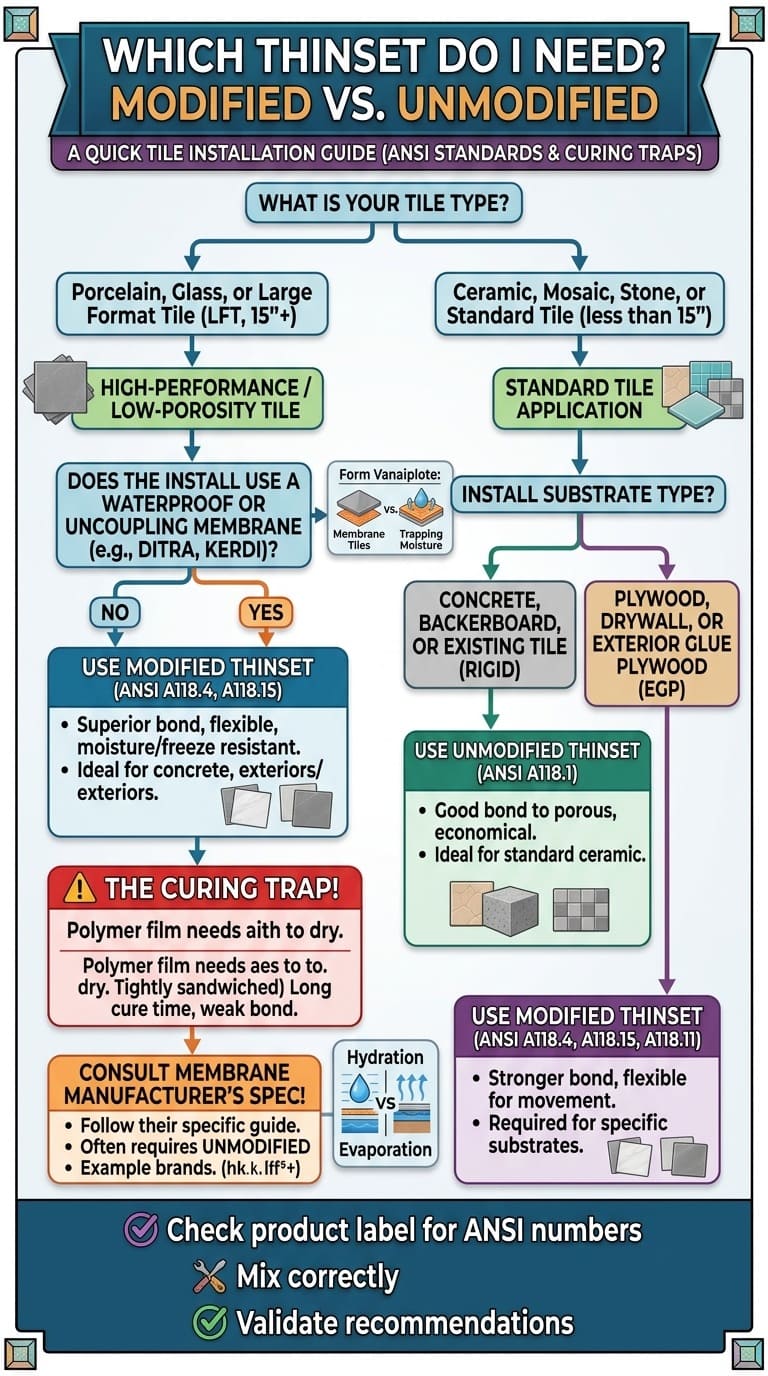
This is the detail that catches a lot of installers off guard. Unmodified thinset cures the way concrete does: hydration, a chemical reaction with the mixing water, that happens whether or not the mortar bed can “breathe.” Modified thinset cures two ways at once — the cement hydrates, but the polymer needs to air-dry through evaporation to form its bonding film.
That’s not an issue when at least one side of the mortar bed is porous. It becomes one when modified thinset gets sandwiched between two impervious layers: a waterproofing or uncoupling membrane on one side, and a low-porosity tile like porcelain on the other. With nowhere for that moisture to escape except through the grout lines, the polymer film can take weeks to fully cure — sometimes longer in cold or humid conditions — and the bond may never reach its rated strength in the meantime.
That’s exactly why membrane manufacturers such as Schluter specify unmodified thinset (or a purpose-built modified mortar formulated specifically for their system) when installing impervious tile over products like DITRA or KERDI. Unmodified mortar doesn’t need to dry out to hydrate, so a membrane trapping moisture underneath actually works in its favor rather than against it.
Bottom line: before you set porcelain or glass over a waterproofing or uncoupling membrane, check that membrane manufacturer’s install guide. Don’t assume modified is the safer choice just because it usually performs better everywhere else.
Large-format tile (LFT) — generally anything 15″ or longer on one side — adds another wrinkle. A standard 1/4″ mortar bed isn’t enough to fully support that much tile without voids underneath, and a mortar that’s too soft lets a large, heavy piece slide or settle unevenly against its neighbor before it sets.
That’s why LFT and heavy stone typically call for a medium bed, or “Large and Heavy Tile” (LHT), mortar — a modified formulation built to trowel up thicker (often to 3/4″) without slumping, sagging, or shrinking as it cures. That non-sag characteristic is what keeps a 24″ x 48″ porcelain plank sitting flat instead of settling into lippage as the bed firms up. A typical application uses a 1/4″ x 3/8″ notch for back-buttering, stepping up to a 1/2″ x 1/2″ or 3/4″ half-loop trowel for the LHT bed itself — check the tile manufacturer’s spec, since undersized trowel notches are a common cause of hollow spots on big tile. Pushing a standard-format modified thinset past its rated buildup thickness is one of the more common causes of lippage callbacks.
| Unmodified Thinset | Modified Thinset | |
| ANSI standard | A118.1 | A118.4 (A118.15 for improved) |
| Composition | Cement, sand, water-retaining agent | Cement, sand, plus polymer or latex additive |
| Cures by | Hydration (chemical reaction) | Hydration + polymer film formation (needs air to dry) |
| Bond strength | Good on porous substrates | Superior; bonds to dense, low-porosity tile |
| Flexibility | Rigid, minimal give | Flexes with substrate movement |
| Moisture/freeze resistance | Limited | Strong |
| Typical cost | Lower | Higher |
| Common uses | Under uncoupling/waterproofing membranes, thick mortar beds, per spec | Porcelain, large-format tile, glass, natural stone, showers, exteriors |
Yes — this is a common approach on job sites. Instead of buying a pre-modified bag, some pros buy a straight dry-set or mortar-bed mix and blend in a separate liquid latex additive to get similar flexibility and bond strength. It’s useful when a job calls for a thick mortar bed with the strength of a modified mix, or when you want to dial in performance for a specific substrate.
A good example is Laticrete’s 226 Thick Bed Mortar. On its own, it’s a premixed, unmodified mud-bed material rated for thick-bed tile installations. Combined with a liquid additive like the Laticrete 3701 Latex Fortified Mortar Bed Admix, it becomes a high-strength, latex-fortified bed suitable for demanding wet and dry applications alike.
The tile and membrane manufacturers’ installation instructions should always take priority over a general rule of thumb — different tile bodies, backings, and membrane systems can carry different requirements, and a mismatch here is a warranty issue, not just a performance one.
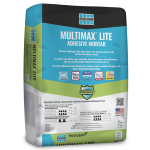
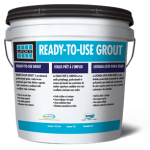
Tile Pro Depot carries a full lineup of polymer-modified thinsets along with the mortar beds and additives you’d use to build a custom unmodified-plus-admix mix:
Browse the full range in the Adhesives, Mortar Beds & Thinsets category at Tile Pro Depot to find the right match for your substrate, tile type, and installation conditions.
No. It’s the more versatile, higher-performing option for most direct-to-substrate installations, but some membrane systems specifically require unmodified thinset because of how each type cures. Follow the manufacturer’s spec sheet for your tile and underlayment, not a blanket rule.
Not recommended on its own, unless a membrane manufacturer’s spec calls for it. Porcelain’s low porosity generally needs the extra bond strength polymers provide — either a pre-modified bag or an unmodified mix with a latex additive blended in.
Check the ANSI number on the bag against the tile manufacturer’s installation guidelines, then cross-reference the substrate or membrane manufacturer’s requirements. When the two don’t obviously align, a quick call to the manufacturer or a Tile Pro Depot rep can save a lot of guesswork — and a callback.

Mitchell Moss works with Tile Pro Depot and contributes practical content for professional tile installers, remodelers, and serious DIY users. His articles focus on tile installation tools, setting materials, waterproofing systems, grout, underlayments, and jobsite techniques. Through the Tile Pro Depot blog, he helps readers better understand product applications, compare installation approaches, and make informed material choices using manufacturer guidance, industry standards, and practical considerations that can affect the durability and performance of a tile installation.